Transcript
CHAPTER 1
Dr. Sheth:
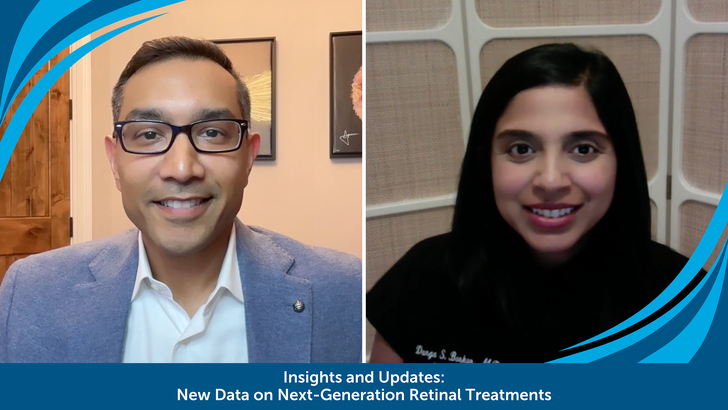
Welcome to the Keeping Pace in Retinal Disease educational series. We're discussing insights and updates on next-generation retinal treatments. In this first chapter, we'll focus on faricimab. This is CE on ReachMD, and I'm Dr. Veeral Sheth.
Dr. Borkar:
And I'm Dr. Durga Borkar.
Dr. Sheth:
Durga, let's start off with an update on the longer-term data for faricimab. What do we know?
Dr. Borkar:
Great question. So we've had faricimab now since early 2022, and so I think the new updates are really focused on that longer-term data that we have, and also real-world data. So YOSEMITE and RHINE were the original phase 3 studies for DME evaluating faricimab. And now what we're looking at is beyond those first 2 years in the YOSEMITE and RHINE trial.
We have the RHONE-X extension data, so that looks at how patients on faricimab fare in years 3 and 4. So the faricimab q8-week arm and the faricimab treat-and-extend arm were transitioned over to a treat-and-extend regimen, and the aflibercept 2 mg q8-week arm was also transitioned over to a faricimab treat-and-extend regimen.
What we see is maintenance of those visual acuity gains that we saw in the first 2 years, as well as that continuation of that CST reduction in years 3 and 4, which is really impressive, because a lot of times when we think about what happens in the real world, it is in those subsequent years that we see the visual acuity fall off or the CST reductions not quite maintained.
And when we look at what happens to patients in terms of absence of DME, greater than 90% of patients achieved absence of DME by the end of the RHONE-X study, regardless of the prior treatment arm that they started in the initial YOSEMITE and RHINE trials.
And when we look at the percentage of patients on extended dosing at the end of 4 years, we see that close to 80% of patients are at, at least a q12-week dosing interval, whether they were in the aflibercept 2 mg q8-week arm, the faricimab treat-and-extend arm, or the faricimab q8-week arm at the initial onset of the YOSEMITE and RHINE trials.
And I think what's further impressive as well is when we look at adverse events through years 3 and 4 in RHONE-X, it's really quite consistent with what we see both in the real world and then also in the YOSEMITE and RHINE studies. Notably, there were zero cases of retinal vasculitis in any of the 3 treatment arms.
But now let's look at some real-world data. I think we're always curious to see how do these novel agents fare in our own hands. So when we look at just the overall unmet treatment need that we have for DME, we know that the treatment burden for DME is high.
And when we look at some of the Vestrum analyses, what we see is compared to clinical trial results, patients are really, over time, not gaining quite as much vision in the long term as what we saw in the trials.
So the FARETINA-DME study is a retrospective, real-world study that leverages data from the IRIS Registry, which is a large EHR registry that covers about 70% of ophthalmology practices in the United States. And in FARETINA-DME, what we see was that vision was really improved in treatment-naïve eyes. There's about a 5-letter visual acuity gain at month 24, and it was maintained in previously treated eyes.
And I think that's impressive for a couple reasons. Maintaining vision in these previously treated eyes that are potentially in years 3, 4, 5, 6 of treatment, because they've switched from other agents, is quite impressive and different than what we typically see. And the other thing is, in the FARETINA study, close to 50% of patients had a visual acuity of 20/40 or better at baseline. So there is a little bit of a ceiling effect, too, when we think about how much vision there is to gain by month 24.
And what we see in the previously treated eyes as well is that CST improved through 2 years of faricimab treatment, and we see about a 65 µm reduction in these previously treated eyes between baseline and month 24. And that might not seem as impressive as that 200 µm decrease that you see in the YOSEMITE and RHINE clinical trials, but it's important to note that the baseline CSTs are much higher typically in clinical trials.
And I think what's most impressive about all of this is that you're seeing these visual acuity outcomes and these anatomic outcomes with far fewer injections after the first 6 months. And patients really are interested in that durability aspect.
And I think that's often why we don't see the visual acuity gains in the real world that we see in trials, because the number of injections just drops off over time. So to be able to see that durability and that associated good visual acuity outcome is really impressive.
So when we think about neovascular age-related macular degeneration, it's somewhat of a similar story in some ways, that real-world AMD patients receive fewer injections than they do in clinical trials. And we know that a higher number of anti-VEGF injections correlates with better visual acuity outcomes in neovascular AMD.
And we saw that even in a clinical trial setting, when we look at the 5-year CATT results, you see initially there's this visual acuity gain up to year 2, and then in those last few years, the number of injections goes down and as does the vision.
And so similar to DME, really looking for a more durable option. So similar study, a real-world study, was done—FARETINA-AMD—also leveraging the IRIS Registry. And we saw very similar outcomes here when we looked at the 2-year data, that both in treatment-naïve and previously treated eyes, the vision was maintained through 2 years of faricimab treatment. And again, it's a similar story that at least 50% of patients had 20/40 or better vision at baseline, which is not typically what you see in clinical trials of course. So we have to contextualize that visual acuity outcome in the context of that.
And when we look at CST, both for treatment-naïve and then also previously treated eyes, we see that there's similarly a reduction in both of these groups. And when we look at the magnitude of the reduction, about 40 µm in the treatment-naïve group and then about 30 in the previously treated. It’s a little different than what you see in trials because that baseline CST is different. And a similar story here, where we see fewer faricimab injections after that first 6 months. So the durability effect is there.
Dr. Borkar:
And of course, when looking at real-world data, everyone is interested in safety. So looking at the FARETINA pooled safety analysis with that neovascular AMD and DME patients, we see comparable rates of endophthalmitis to what we saw in the phase 3 clinical trials. And there were actually no cases of retinal vasculitis.
A similar study was done looking at the Vestrum database as well, and they found comparable rates of retinal vasculitis when looking at faricimab injections compared to other anti-VEGF agents available at the time, and again zero cases of occlusive retinal vasculitis.
Now, there is other real-world data out there. The TRUCKEE study is also looking at the real-world efficacy and safety of faricimab. Veeral, what do those recent data show?
Dr. Sheth:
Yeah, that's a great question, Durga. So like you said, this is also real-world data but slightly different than what you've been showing, which is these large datasets from Vestrum and from IRIS registries, those type of registries. This is actually a consortium of practices across the country that's looking at collecting data proactively on their faricimab patients.
So with TRUCKEE, we're looking at neovascular AMD real-world efficacy. And really the focus on this cohort is really looking at treatment-naïve patients, but also those patients that are switching from another agent.
I think of particular interest are those patients that were switched from aflibercept 2 mg. That seemed to be the largest switch group. And when we looked at those patients, one of the interesting things we saw was that with patients that have received multiple injections—in particular, 9 injections—we see that their durability has increased by 14.5 days. And so again, with these new generation agents, we're looking at improvements in durability, and we're seeing that in the real world.
So what about vision? We're seeing kind of similar patterns in terms of vision. In particular, let's focus on those switch patients. When we switch patients, they were at about 60 letters of vision, and after 18 months after their switch, they're at 61.9 letters. So again, this sustained vision. We're not seeing that drop-off, Durga, that you had mentioned before with a study like the CATT study, for example.
And then what about anatomy? So what we're seeing in those switch patients again is improvement in fluid reductions over 5 treatments. So here's a nice chart that shows you when we see those patients initially, they're at about 44.9 days between their injections with a significant amount of fluid. You switch them over, you give them 5 injections, and you look—significant reduction in fluid volume. And in addition to that, you're still improving and increasing their durability.
In terms of safety, again, in line with what you talked about already, which is a low number of IOI rates, low number of endophthalmitis, really in line with what we saw in the phase 3 and real-world studies.
So switching gears, I also want to talk a little bit about some post hoc analysis with faricimab and some of the things we've seen in terms of biomarkers and anatomical benefits.
So first we looked at macular leakage. So YOSEMITE and RHINE—we talked about this large phase 3 study—and when we look at some of the subanalysis there, we look at patients and their FAs at week 16. And we saw a 53% benefit in faricimab patients over aflibercept in terms of patients that had no macular leakage.
When we look at BALATON and COMINO, which were for BRVO and CRVO, respectively, we see a similar pattern. So in other words, patients receiving faricimab had less macular leakage after receiving faricimab versus the patients that received aflibercept.
Another biomarker we like to look at in our diabetic patients are hard exudates. So in addition, we also saw in YOSEMITE and RHINE a reduction in hard exudates through week 96 in patients that started with hard exudates.
Similar pattern with hyperreflective foci. Again, we see these patients that have hyperreflective foci, and we saw both in the inner retina and in the outer retina faster resolution with faricimab of these hyperreflective foci versus the patients that received aflibercept.
In our neovascular AMD patients, we like to look at PED thickness. And in the TENAYA and LUCERNE trials, we saw that in the post hoc analysis in the matched treatment setting, we saw a greater reduction in PED thickness in patients receiving faricimab versus aflibercept.
And then in that TENAYA/LUCERNE study, we also saw some interesting safety data. We saw RPE tears that were associated with larger baseline PED heights, which is in line with what we've seen in the real world as well.
And so just in general, key takeaways from this are that long-term clinical trial and real-world data are showing that faricimab is safe and durable as a second-generation agent. We see that in the real-world, treatment-experienced patients are maintaining vision over time, as opposed to past real-world studies where we saw those declines. And in addition, the Ang2 suppression provides potentially anatomic benefits, some of those biomarkers that I talked about.
So that summarizes faricimab. And let's stay tuned for Chapter 2, where we'll be discussing the latest data around aflibercept 8 mg.
End Chapter 1
CHAPTER 2
Dr. Borkar:
Welcome back. In the first chapter, we covered the latest data around faricimab. Now, let's take a look at the most recent data for aflibercept 8 mg. Veeral, what can you tell us?
Dr. Sheth:
Yeah, so we know and have seen kind of results for the PULSAR and PHOTON studies for 8 mg of aflibercept. And now we're getting to see some extensions on those studies. So we're going into year 3 for those trials.
So let's start with the PULSAR study. In PULSAR, we saw that we compared aflibercept 2 mg patients that were getting dosed every 8 weeks versus 8 mg patients that were getting dosed at various intervals. And we saw at the 2-year study that those vision gains were maintained and that the 8 mg group was noninferior to the 2 mg group.
And when we march that out another year in the extension, we see that, again, a similar pattern. Patients do very well. Vision gains are maintained. And in patients that switch from 2 mg to 8 mg, those patients do very well as well, with a mean number of injections from week 96 to week 156 of 4.7 injections in the switch group, and 3.8 in the 8 mg group, which shows us good durability of this medication.
When we look at anatomic findings, again, we see that the CST was maintained through 156 in these patients, in both groups—in patients that were already on 8 mg before the extension started, and in patients that went from 2 mg to 8 mg. So again, reassuring that we're seeing good BCVA as well as CST findings even at the end of 3 years in these trials.
In terms of durability, we see that aflibercept 8 mg-treated patients who were assigned at the very end of their study—we see that 43% of them were assigned at a 20-week interval, and 62% were at 16 weeks or longer. And in other words, we are able to extend these patients out, the majority past 4 months, and 43% are assigned at that 20-week mark. So we're really kind of coming a long way with these new generation of treatments in terms of extended dosing intervals.
In terms of safety, we saw that in this extension, we saw again continued safety with these 8 mg patients. The concern always with a higher dose is are we going to see more adverse events, and the answer here is no. We saw pretty much similar profile in the 8 mg group as we have seen in the 2 mg group. And the 2 mg real-world data we know we've seen for many, many years good safety profile for this aflibercept medication. So that's again reassuring to see that safety data in the extension study.
So now let's look at some real-world data, where we get to leverage much larger datasets, including IRIS and Vestrum.
So when we look at some of this data, let's look at first treatment-naïve patients. We see that patients that are getting their loading dose, the treatment interval is about 38 days, and we do see patients go to about 70 days after their loading phase. And so this is again kind of in line with what we saw in the clinical trials.
The question then is, what about those patients that we switched over? So let's take a look at those patients. First, who are these patients? Patients were being switched over primarily from aflibercept 2 mg. You can see how it breaks down, which is not surprising, given that 2 mg was widely used.
And in patients that had longer intervals to begin with, like 6 to 8 weeks already, we saw a 2-week interval extension in those patients. And so we're seeing about a 2- to 3-week extension on patients that were receiving a previous agent—could have been 2 mg—and now receiving 8 mg of aflibercept.
Let's look at the PHOTON data. PHOTON now, again, is looking at primarily patients that have DME instead of AMD. And again, much like PULSAR, we're now seeing a 3rd year of data in these patients. And when we look at that data, we see that vision gains are maintained, as well as CST thickness is stable in these patients at the end of year 3. These are patients that were previously receiving 8 mg or 2 mg. And if they were receiving 2 mg, they were switched over to 8 mg. So all these patients at the end of the extension were receiving 8 mg—and again, seeing good stability at the end of that 3rd year.
We also have good real-world data that we're starting to get for these patients as well, again leveraging the IRIS and Vestrum data. And when we look at those early insights, we see, again, patients in the initial dosing phase at about a 41- or 42-day dosing interval, in line with their loading dose. And then after their loading dose, we're seeing about a 77- or 75-day interval dosing, which means that they're really kind of extending out as predicted.
Now, what about those patients again that are switching over? Again, a lot of those patients are switching over from aflibercept 2 mg and similar. So patients that were already at a shorter interval—4 to 6 weeks—we're seeing some extension in those patients, 3 to 4 weeks after switching. And again, patients that were already at 6 to 8 weeks, we're seeing 2 to 3 weeks of extra extension in those patients as well. So again, we're seeing those patients switch. We're seeing that durability as expected with the 8 mg.
Dr. Sheth:
For those just tuning in, I'm Dr. Veeral Sheth, and here with me today is Dr. Durga Borkar. Today, we're discussing the most recent data around second-generation retinal treatments.
Now, we see 8 mg is evaluated in patients with RVO as well in the QUASAR study. Durga, what did this data show?
Dr. Borkar:
Great question. The QUASAR study was a phase 3 study looking at aflibercept 8 mg for treatment-naïve macular edema secondary to RVO. Patients in this study were randomized to receive either aflibercept 2 mg every 4 weeks, aflibercept 8 mg every 8 weeks after 3 initial monthly injections, or aflibercept 8 mg every 8 weeks after 5 initial monthly injections.
And the primary endpoint was—it was a noninferiority study—at week 36, they looked at change from baseline in BCVA. And the secondary endpoints at week 36 were the number of active injections from baseline and the change from baseline CRT. The end of the study was technically at week 64, so the study did meet its primary endpoint.
And I think what's also further impressive is when we look at the anatomical benefit here, where we look at the reductions in CST with fewer injections. So we see that from baseline to week 36, there's about a 370 µm decrease in CST regardless of which treatment arm you're in. But when you look at the 8 mg groups, they received about 6 to 6.5 injections through week 36 compared to 8.5 injections in that 2 mg q4 group. And so the treatment burden is significantly reduced for that visual acuity and anatomic outcome.
And then when we look at the last-assigned dosing interval at week 36 in these extension-eligible patients, the dosing interval extension not possible in that initial 5 loading dose group until week 40. So this is just looking at the 8q8 with the 3 initial loading doses and then the 2 mg q4. What we see is that in the 2 mg q4 group, about 75% had achieved q8-week last-assigned dosing interval, but close to 70% in that 8 mg q8-week had achieved a q12-week interval. So certainly seeing increased durability there.
And one thing that people always think about with aflibercept 8 mg is are there any issues with IOP, given the slightly greater volume?
And when you compare the aflibercept 8 m- treated eyes to aflibercept 2 mg-treated eyes in these 2 trials, what we see is that baseline IOP is about the same in the 2 groups. And then the difference in mean change in IOP is really comparable between the aflibercept 8 mg-treated eyes and the 2 mg-treated eyes—and this was measured between 30 to 60 minutes after injection.
A similar real-world study was also done looking at 90 patients with either AMD or DME. But this was comparing 30 seconds, 5 minutes, and 15 minutes postinjection and looking at aflibercept 2 and 8 mg, and then also faricimab. And you see a similar transient IOP spike across all 3 agents that then trends down very nicely, back very close to baseline at 15 minutes.
Dr. Sheth:
That's fantastic. So just to summarize, we saw that in PHOTON and PULSAR extension studies, we saw that aflibercept 8 mg continues to provide durable improvements in BCVA and CST reductions through week 156. And the early real-world insights are very interesting as well—we're seeing dosing intervals increase, especially with those patients switching to the 8 mg. And we're looking at QUASAR data as well to show that aflibercept is an effective treatment, as you mentioned, for RVO. Safety studies are showing transient spikes in pressure, which you mentioned, after intravitreal injections, but additional volume of aflibercept basically causes minimal increase in transient IOP fluctuation. So that's reassuring as well.
Dr. Borkar:
Those are great points. Stick around for our next discussion where we'll look at the newest data with the port delivery system in Chapter 3.
End Chapter 2
CHAPTER 3
Dr. Sheth:
Welcome back. In the first 2 chapters, we discussed the latest data around faricimab and aflibercept 8 mg. Now, let's take a look at the newest data for the port delivery system with ranibizumab. Durga, what updates have been made to the implant itself?
Dr. Borkar:
It's a great question. So when looking at the implant itself, the updated implant has double the septum overmold bond strength versus the voluntarily recalled implant. And I think that's important when you think about the septum dislodgement concern that was there before. This is a big improvement. And the updated refill needle itself requires half the insertion force of prior refill needles. And the great thing is that now it's approved not only for neovascular AMD, but also for DME and DR.
So let's just go through the PAGODA study for DME, which looked initially at the PDS implant and then with the refill every 24 weeks, compared to ranibizumab basically given monthly—q4 weeks—up to week 64. And then when you look into year 2, actually it was a crossover where those intravitreal ranibizumab patients also received the PDS implant. So we got to see how both of these groups fared, going up to week 112, and the results are quite striking.
So when we look at the change from baseline BCVA through week 112, we see that those visual acuity gains of approximately 10 letters from baseline are maintained up to week 112. And it doesn't actually matter which group you started in, which is good to know since we are looking at many treatment-experienced patients receiving this implant in the real world.
When we look at CST improvements from baseline through week 112, it's a very similar story—that regardless of which arm you started in, there's about a 200 µm CST reduction at week 112, and you can see it's really nicely maintained.
The other thing that's interesting here is that this was a DME study but, of course, we want to look at peripheral retinopathy severity. And so what we see is that between 43 to 45% of eyes in this study had at least a 2-step improvement from baseline in their DRSS score at week 112. And that, again, is regardless of which arm you started in. The supplemental treatments in the study were very minimal. So between 95 to 97% of patient eyes did not receive any supplemental treatment through week 112.
And I think this case from the PAGODA study is really fascinating, because there's the study eye which received the PDS implant, and then the fellow eye that received just standard-of-care intravitreal injections. And what we see here is that at baseline, this patient in the study eye starts with a BCVA of 67 letters and improves to 78 letters at week 112. And the anatomy is really fascinating here, because when you look at the baseline OCT, you see a lot of biomarkers like hyperreflective foci, exudates, a large central cyst, subretinal fluid that suggest this is going to be a really refractory case. And that OCT looks great at week 112. And you know, the fellow eye does well as well, but the patient receives 19 intravitreal injections through week 112. And so when you think about treatment burden, really, there’s quite a difference there.
And of course, safety is important to everyone, especially with novel drug delivery systems. And so what we see here is that when we look at cases of endophthalmitis, there were 4 cases of endophthalmitis in both the study arms going up to week 112, and all of these events had resolved. The refill exchange procedures were resumed in all patients. And 2 patients' BCVA actually recovered vision to baseline or to 20/40 or better with treatment, and 1 patient’s vision actually improved by 12 letters compared to baseline.
So the PDS implant has also been studied in patients with severe NPDR without center-involving DME. Veeral, can you tell us about the results from the PAVILION trial?
Dr. Sheth:
Yeah, no, it's a great question. And before we get into the PAVILION study, we really should talk about PANORAMA, where we learned that increases in leakage and nonperfusion can really increase the risk of worsening retinopathy. And we like to talk about 2-step DRSS worsening. So that's kind of the context of why the PAVILION study was done.
So with the PAVILION study, we looked at patients with severe NPDR without center-involving DME. And those patients were randomized to either get the port delivery system implant from day 1 or they were in the control group and didn’t receive any treatment—much like our kind of standard of care at this point. And so when those patients received the port delivery, they also were able to get refills at every 36-week intervals, which is a little bit different than the PAGODA study that you talked about earlier.
So when we look at the outcomes, we look at 2-step improvements in DRSS scores. And we see that patients do very well when they receive that implant. By the end of the 100 weeks, they're at 80% of those patients that receive the PDS implant along with those q36-week intervals—80% of those patients demonstrate a 2-step improvement in their DRSS score.
And in patients that were originally in the control group but then were allowed to switch over to receive the port delivery, they also do very well, and 91.7% demonstrate a 2-step improvement at the end of the 100 weeks. So again, showing that this continuous delivery can help with stabilizing diabetic retinopathy.
In terms of center-involving DME and other vision-threatening complications, we see a reduced rate of VTCs in patients receiving the port delivery system. We see less DME, less vision-threatening complications, which include things like vitreous hemorrhages, in the port delivery group versus the control group.
In terms of looking at the angiogram—so similar, Durga, to what you showed earlier—we see when patients receive this continuous delivery of ranibizumab, we see an impact on their fluorescein angiograms. We see less leakage overall, less neovascularization, which is really kind of why we see less of these VTCs to begin with—less DME, less conversion to PDR, and vitreous hemorrhages.
In terms of adverse events, you talked about kind of the structure of these implants and how they changed them. Of particular interest, were looking at things like endophthalmitis and what are the rates like. And we saw really low rates of endophthalmitis in this study, so there’s 1 in the PDS group, which again, we're looking at kind of the evolution of this port delivery system over time, and lower rates of endophthalmitis over the course of these trials.
Dr. Borkar:
Well, we've covered a lot. Updates to the PDS implant and refill needle make it safer and easier to refill. The PDS is now approved for patients with either DME or diabetic retinopathy. In the PAGODA trial, patients maintained good vision and reductions in CST with refills every 24 weeks. And in the PAVILION trial, patients with severe NPDR maintained a 2-step or more DRSS improvement with dosing every 36 weeks. Rates of vision-threatening complications or development of center-involving DME were low or decreased with the PDS.
Dr. Sheth:
Excellent points. Well, that's all the time we have for today. Thank you to our audience for joining us, and thank you, Durga, for being here.
Dr. Borkar:
Thank you.
End Chapter 3